
Constellation Cascade: The Understated Structural Shift in Connectivity from Low Earth Orbit Satellite Ecosystems
This paper examines a subtle but transformative signal within the future of connectivity: the systemic shift toward highly integrated, AI-driven Low Earth Orbit (LEO) satellite constellations acting as foundational infrastructure beyond mere internet provision. This evolution could recalibrate capital flows, regulatory paradigms, and industrial architectures over the next 10–20 years.
Recent space industry developments, particularly SpaceX’s Starlink progression, reveal not just a broadband expansion but an epochal change to how global connectivity and data ecosystems operate. The signal moves beyond existing discussions of satellite internet as an alternative broadband to a layered, multi-sector digital infrastructure poised to disrupt terrestrial networks, governance models, and AI deployment strategies worldwide.
Signal Identification
This development qualifies as an emerging inflection indicator given its nascency but rapidly growing momentum, grounded in tangible deployments and investment, yet underappreciated for its broader systemic effects. The timeline is a 10–20 year horizon reflecting capital gestation periods, regulatory evolution, and infrastructure scaling constraints. The plausibility is high due to convergent trends in satellite deployments, AI integration, and urgent connectivity demands linked to IoT, climate monitoring, and space industrialization.
Sectors exposed include telecommunications, aerospace manufacturing, internet infrastructure, AI ecosystems, regulatory agencies (communications and space policy), and capital markets involved in space ventures and critical infrastructure.
What Is Changing
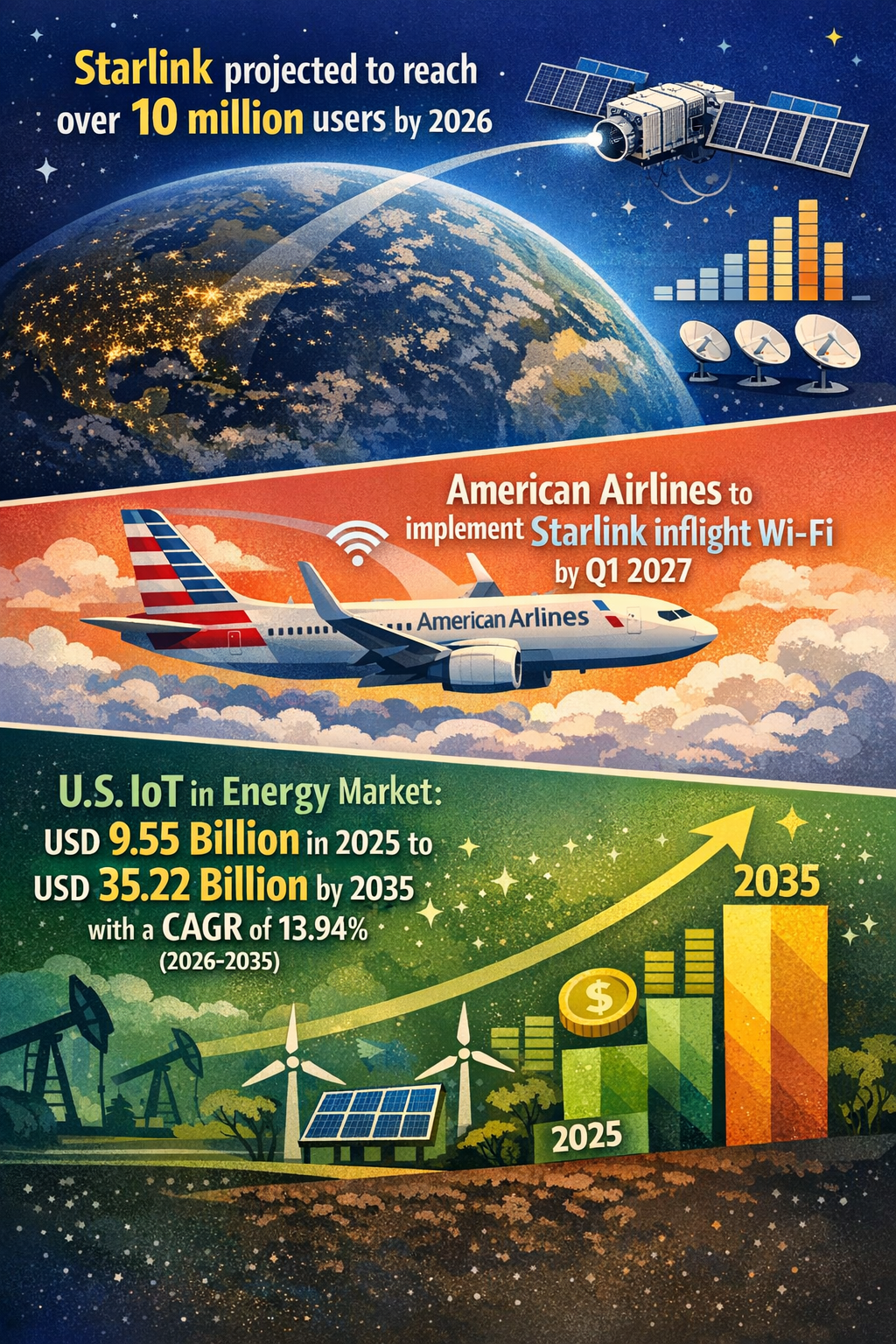
Multiple contemporaneous developments signal a substantive structural theme: the fusion of satellite mega-constellations with autonomous, AI-enhanced operational capabilities to form a new class of digital infrastructure. SpaceX’s Starlink business is accelerating from niche broadband toward becoming a dominant global connectivity platform, evidenced by its inflight Wi-Fi engagements with American Airlines starting 2027 (9to5Mac 26/05/2026).
Simultaneously, the Starship upper stage plans to deploy next-generation Starlink V3 satellites and specially modified satellites emphasize continuous hardware innovation and scale in orbit (RocketLaunch 27/05/2026). These in-space upgrades suggest a relentless drive toward autonomous maintenance and expansion of constellation capabilities.
Moreover, as noted by IndiaToday, demand for LEO constellations is increasing globally due to a rise in Internet of Things (IoT), Earth observation, and climate monitoring applications, which require low-latency, ubiquitous connectivity (IndiaToday 23/05/2026). This signals a systemic pivot not only in the volume of data generated but in its criticality for global regulatory compliance, environmental risk management, and autonomous system operation.
What is genuinely under-recognised amidst these noise layers is the structural emergence of satellite constellations as inseparable AI/data infrastructure, transcending traditional satellite internet or launch business valuations. This is highlighted by valuations ranging up to $30 trillion predicated on Starlink’s constellation combined with reusable rocketry and AI infrastructure potential (AOL 26/05/2026).
Significantly, the next generation of IoT and smart ecosystems expected in 2026 and beyond will rely on “highly autonomous ecosystems powered by AI, quantum computing, advanced robotics, and predictive intelligence,” which satellites in LEO could uniquely enable on a global scale (Differ 22/05/2026). This moves satellite connectivity from an access utility to a core digital nervous system underpinning AI-powered global autonomy.
Disruption Pathway
The evolution of AI-enabled satellite constellations could accelerate through several causal mechanisms. First, as terrestrial network saturation and geopolitical fragmentation increase, LEO networks will gain preference for resilient, low-latency connectivity in remote, mobile, and contested environments. Increased demand from emergent autonomous IoT devices, climate risk monitoring, and space sector data generation will create vast revenue streams enabling reinvestment into constellation upgrades and AI operational autonomization (IndiaToday 23/05/2026).
Next, stress arises from incumbent broadband providers and regulatory frameworks oriented around terrestrial or geostationary satellite infrastructures. Existing spectrum governance and national security paradigms are ill-equipped for dense AI-managed LEO fleets offering cross-border, nearly real-time global service. This could drive calls for new multi-jurisdictional governance models and cross-sector regulatory bodies combining space policy, communications law, and AI oversight.
Industry players may adapt by vertically integrating—combining launch services, satellite manufacture, AI software, and downstream applications, as demonstrated by SpaceX—that achieves economies of scope and control over the complex ecosystem (Hindustan Times 25/05/2026). This integration may marginalize traditional telecom incumbents, consolidate trillions in market capitalization into space systems firms, and redefine strategic industrial clusters.
Feedback loops emerge as enhanced situational data from constellation IoT feeds bolster AI predictive capability, improving network efficiency and global digital services. However, this also introduces systemic vulnerabilities where constellation outages or AI failures could cascade across critical infrastructure, pressing governments to enforce new resilience and liability standards.
Altogether, these dynamics could recalibrate dominant connectivity and space governance models from siloed national frameworks to internationally harmonized, AI-centric regulatory ecosystems tasked with overseeing complex, multi-domain, space-terrestrial networks.
Why This Matters
For decision-makers, ignoring the structural implications may lead to misplaced capital allocation and regulatory blind spots. Investors and industrial strategists should anticipate a redirection of capital toward vertically integrated satellite-AI ecosystems as they outperform discrete segments like terrestrial ISPs or standalone launch services.
Regulators must prepare for paradigm shifts in spectrum management, cross-border data governance, and AI safety oversight embedded within constellation operations, requiring new legal instruments and multi-agency collaboration.
Supply chains in aerospace manufacturing and semiconductor industries will need to evolve to support iterative, autonomous satellite fleets with embedded AI, while existing telecom operators face existential disruption or potential collaboration strategies.
There are also liability and governance consequences if constellation operational failures disrupt critical global IoT or autonomous infrastructure, intensifying requirements for accountability frameworks, disaster recovery protocols, and cybersecurity regimes specific to space-AI infrastructure.
Implications
This development might delineate a bifurcation in the future of connectivity where legacy terrestrial networks coexist with a dominant, AI-driven LEO satellite infrastructure that could re-center global digital power. It is likely to catalyze shifts in capital allocation favoring space-tech and AI hyphenated firms over traditional telecoms and network operators.
The signal could lead to permanent industrial structural change by fostering fully autonomous, AI-managed satellite constellations functioning as global digital property, rather than incremental broadband providers. Regulatory frameworks might transform to accommodate these cross-domain systems, potentially initiating internationally coordinated governance models.
This signal is not a simple overlay of current broadband services but a foundational reimagination of global connectivity architecture integrated with AI and IoT. It is not guaranteed to unfold without friction or potential setbacks such as geopolitical restrictions, launch failures, or AI operational errors, which would slow but not nullify the trajectory.
Some interpretations emphasize terrestrial 5G/6G rollout or fiber-optic expansion as dominant connectivity futures but these often underweight the rapid maturation of constellation auto-scaling and AI integration capabilities, which could leapfrog legacy infrastructure, especially in underserved regions and globally mobile domains.
Early Indicators to Monitor
- Rising capital allocation shifts toward integrated satellite-AI platform ventures and joint space-AI startup funding clusters.
- Patent filings for autonomous satellite swarm management, AI constellation control algorithms, and cross-domain cyber-physical network interoperability.
- Regulatory drafts proposing new frameworks for AI oversight embedded in satellite constellations and international spectrum resource management.
- Expansion of contract awards for inflight and remote IoT satellite connectivity, beyond consumer broadband.
- Formation or announcements of multi-sector consortiums combining aerospace, telecom, and AI stakeholders for coordinated constellation governance standards.
Disconfirming Signals
- Significant failures in autonomous satellite launch and management that stall constellation scaling and undermine commercial viability.
- Institutionalized prohibitive spectrum protectionism halting cross-border constellation operations or AI integration at scale.
- Emergence of superior terrestrial AI-enabled network technologies that economically outperform LEO infrastructure.
- Major regulatory clampdowns fragmenting global markets and preventing international coordination on space-based AI connectivity frameworks.
- Substantial security breaches or cascade failures causing loss of trust in AI-managed satellite systems leading to widespread operational restrictions.
Strategic Questions
- How should capital allocation strategies adjust to account for vertically integrated space-AI infrastructure firms in contrast to traditional telecom operators?
- What regulatory principles and multi-jurisdictional governance models will ensure safe scaling and equitable access to AI-driven satellite connectivity ecosystems?
Keywords
LEO Satellite Constellations; Starlink; AI Infrastructure; Autonomous Satellites; Space Governance; Internet of Things (IoT); Satellite Internet; Telecommunications Regulation; SpaceX; Digital Infrastructure
Bibliography
- The good news for investors is all three divisions of SpaceX are growing, but it will be interesting to see if the Starlink Internet business becomes more dominant, as the WSJ article implied. Navellier & Associates. Published 27/05/2026.
- American Airlines announced today that it has tapped Starlink's satellite internet service to power inflight Wi-Fi starting in Q1 2027. 9to5Mac. Published 26/05/2026.
- Starlink and SpaceX's launch business could justify a $1.75trn valuation by themselves. Hindustan Times. Published 25/05/2026.
- As technologies like IoT, climate monitoring, and Earth observation scale globally, demand for Low Earth Orbit satellite constellations will continue to rise. India Today. Published 23/05/2026.
- The Starship upper stage will target multiple in-space and reentry objectives, including a payload deployment of 20 Starlink simulators, similar in size to next-generation Starlink V3 satellites, and two specially modified Starlink satellites. RocketLaunch. Published 27/05/2026.
- SpaceX could ultimately reach a valuation between $10 trillion and $30 trillion over the next 10 to 15 years, driven by Starlink satellite internet, reusable rockets, Starship heavy launch systems, and future AI infrastructure opportunities. AOL. Published 26/05/2026.
- Emerging Startup Trends Beyond 2026 The next generation of IoT innovation will focus on highly autonomous ecosystems powered by AI, quantum computing, advanced robotics, and predictive intelligence. Differ. Published 22/05/2026.