
The Hidden Hydrological Nexus: Water Scarcity as a Silent Inflection in Critical Mineral and Energy Resource Scarcity
Water scarcity is often discussed in isolation from resource scarcity yet may become a pivotal constraint shaping capital flows, regulatory frameworks, and industrial realignments in natural resources and clean energy sectors. Emerging recognition of water’s role in midstream critical mineral processing and energy resource firming reveals a non-obvious, systemic inflection point with multi-decadal impact.
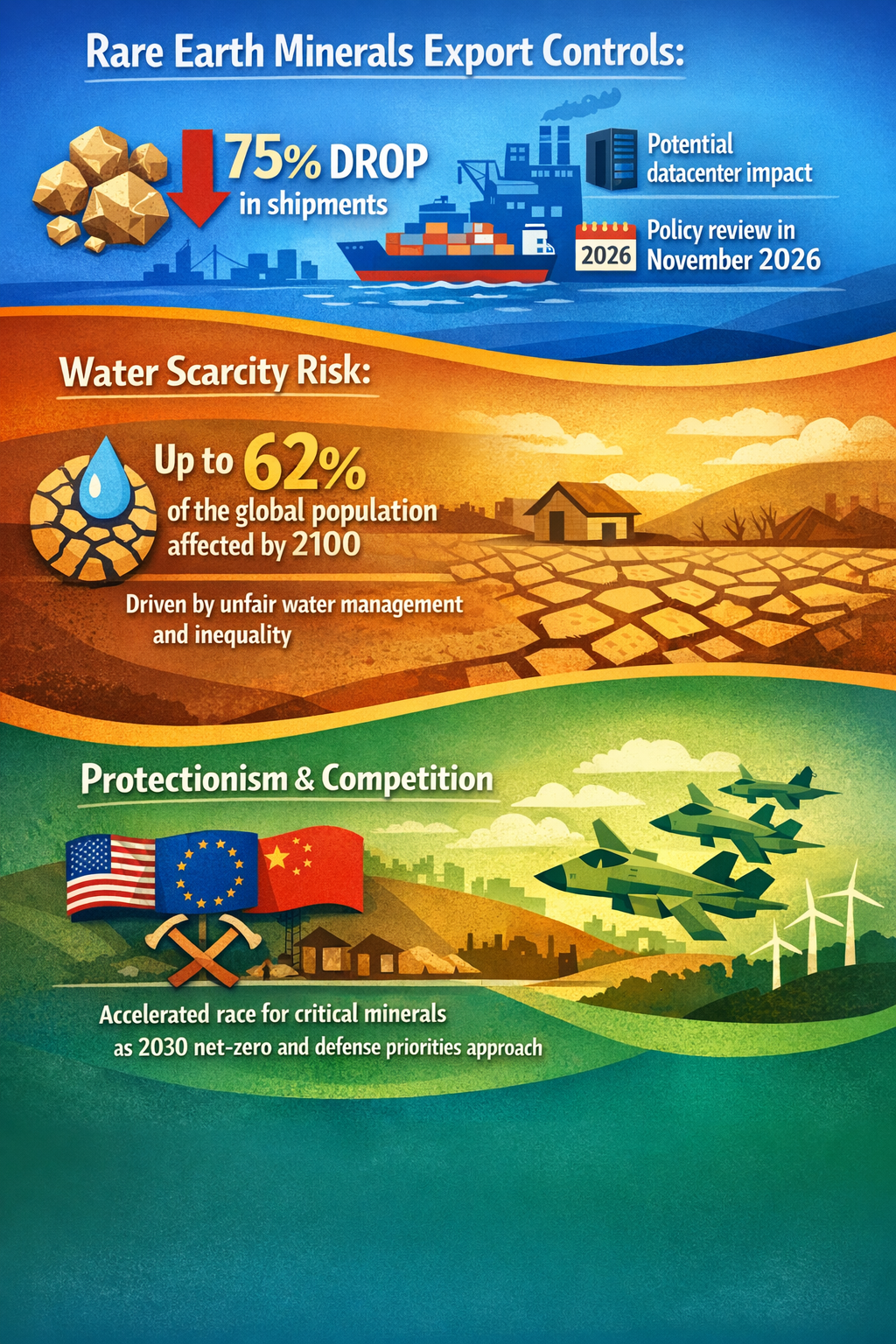
While mineral criticality and renewable energy transitions dominate strategic narratives around resource scarcity, a cross-sectoral weak signal is the intensifying water scarcity crisis, especially in mineral-rich and energy-dependent regions. This water limitation threatens to bottleneck scaling of vital industries and alter geopolitical and industrial structures. With projections of severe water stress for as much as 62% of the global population by 2100 due to climate and inequality, this signal extends beyond an environmental externality to a core driver of structural change in resource supply chains, capital deployment, and governance models (Human Concern 04/04/2026).
Signal Identification
This development qualifies primarily as an emerging inflection indicator. It transcends traditional discourse on critical mineral and energy resource scarcity by embedding water availability as a binding resource requisite for scaling extraction, processing, and manufacturing. It is neither widely recognized nor integrated systematically in capital investment or policy frameworks governing resource futures. Given climate projections and geopolitical tensions around water, its horizon is medium to long-term (10–20 years) with a medium to high plausibility band. Sectors exposed include mining and critical minerals processing, energy resource management (notably natural gas and renewable firming), and agricultural supply chains.
What Is Changing
There is growing discourse around increasing critical minerals production to support clean energy transitions with calls for national midstream mobilization plans in the United States, targeting 2027, 2030, and 2035 capacity milestones, anticipating shared pilot facilities and Defense Production Act financing for scale-up (REEx 01/03/2026). However, these plans inadequately account for the latent water constraints embedded in critical mineral extraction and processing.
Australia’s continued reliance on natural gas to firm renewable energy and support high-heat manufacturing further complicates the resource nexus due to water-intensive processes inherent in gas extraction and critical minerals processing (Geoscience Australia 15/02/2026). The interconnected nature of energy and mineral resource dependency with water usage is underappreciated but materially significant for strategic planning.
International cooperation, such as the U.S.-Peru critical minerals working group established to capitalize on shared resource development opportunities, generally omits integrated water governance strategies, despite many mineral-rich locales concurrently facing water stress (Mirage News 21/03/2026). Similarly, Middle East and African regions forecast steady growth in food and agriculture technology precisely because water scarcity and harsh climates drive urgent demand for improved water and food self-sufficiency, underscoring water scarcity as a cross-sectoral, geopolitical stress point (Market Data Forecast 11/04/2026).
These developments point to a systemic theme: water scarcity is an under-recognized bottleneck critical to the scalability of mineral and energy supply chains. Its systemic role is deeper than a sector-specific externality—it forms a fundamental constraint that will reshape industrial geographies, regulatory enforcement, and capital allocation priorities. Failure to integrate water scarcity risk into resource strategy upstream risks stranded assets and geopolitical instability.
Disruption Pathway
Water scarcity could escalate from a localized operational challenge to a structural constraint through a sequence of reinforcing dynamics. First, regional water shortages intensify due to climate change, population growth, and competing demands from agriculture and urbanization, heightening operational costs and regulatory pressures in mining and energy sectors.
Second, as midstream critical minerals processing scales—critical to battery metals and rare earths for clean energy technologies—the water dependency magnifies. Projects in water-stressed zones face bottlenecks, resulting in production delays or investment diversion to better-watered jurisdictions or to projects employing advanced water recycling technologies. Regulators may enact stricter water use permitting, driving up compliance costs and shifting industrial clustering.
Third, industries adjust structurally by relocating or redesigning processing facilities to optimize water usage, increasing integration of water-efficient technologies, or accepting reduced throughput to meet sustainability criteria. Governments might embed water security explicitly into strategic mineral initiatives, including potential cross-border water-resource treaties linked with mining cooperation agreements like the U.S.-Peru MOU.
Fourth, feedback loops could emerge where water scarcity pressures accelerate innovation in low-water extraction and processing methods, but transitional periods incur cost inflation, supply chain disruptions, and geopolitical friction over transboundary water allocations. These disruptions might undermine dominant industrial and governance models that historically separated water resource management from mineral and energy policy, pushing towards integrated resource governance frameworks at national and international levels.
Why This Matters
For senior decision-makers, this inflection demands reassessment of capital allocation risks. Mining and energy projects lacking integrated water-risk evaluation may face scaled project overruns, delays, or cancellation—imposing stranded asset risk. Regulators will face pressure to harmonize water and resource governance, complicating permitting and enforcement landscapes.
Industrial strategy could see geographic shifts favoring regions with reliable water governance and infrastructure, recalibrating competitive dynamics among countries rich in critical minerals. Supply chains for clean energy technologies may face delays or cost escalations as upstream water constraints are internalized, potentially shifting the timeline of the energy transition.
Liability frameworks may emerge where companies are held accountable for exacerbating water stress in vulnerable regions, raising ESG risk premiums. Governance models that treat water and mineral resource policies in silos risk obsolescence as integrated resource scarcity demands holistic management approaches.
Implications
Water scarcity may become a structural governor of the global minerals and energy systems rather than a peripheral environmental concern. Capital providers might increasingly require water-risk mitigation credentials to underwrite projects, affecting project finance and valuation.
Regulatory frameworks could evolve towards integrated critical resource governance, combining water, energy, and mineral resource permitting and monitoring, potentially elevating agencies that manage water resources in strategic importance relative to energy and mining regulators.
This development is likely not a transient compliance issue but a systemic inflection reshaping supply chain location choices and technology development priorities. However, there may be competing interpretations that technological innovation in water recycling and desalination could sufficiently buffer supply constraints, delaying structural change.
Early Indicators to Monitor
- Emergence of cross-sectoral government policies integrating water and critical minerals/energy resource management.
- Increased capital allocation towards water-efficient mining and processing technologies, evidenced by venture funding and R&D patents.
- Formation of new international accords or working groups addressing water-resource sharing linked to mineral and energy cooperation, beyond traditional trade agreements.
- Regulatory drafts that embed water sustainability criteria as prerequisites for mine and energy project approval.
- Shifts in project siting patterns favoring regions with demonstrable water security infrastructure and governance.
Disconfirming Signals
- Breakthrough, commercially viable technologies rendering water usage in mining and energy negligible or recyclable at near-zero environmental cost.
- Robust expansion of water infrastructure, such as desalination, at scale and competitive cost, decoupling water scarcity from mineral and energy production constraints.
- Persistent political and institutional fragmentation preventing integrated water-resource governance reforms, leading to regulatory inertia that sustains status quo.
- Stable or increasing water supply despite climate projections, possibly due to unexpected hydrological cycles or geomorphological shifts mitigating scarcity.
Strategic Questions
- How will capital deployment strategies adapt if integrated water-risk stress tests become standard requirements for mining and energy projects?
- What governance innovations might emerge to unify water, energy, and minerals policymaking and regulatory oversight, and how will this reshape industry-state relationships?
Keywords
Water Scarcity; Critical Minerals; Resource Scarcity; Midstream Processing; Energy Transition; Regulatory Frameworks; Supply Chain Resilience
Bibliography
- REEx calls for a National Critical Minerals Midstream Mobilization Plan with 2027, 2030, and 2035 capacity targets, shared pilot facilities, and Defense Production Act financing. Rare Earth Exchanges. Published 01/03/2026.
- Australia's energy resources, including natural gas, will continue to play an important role in firming renewable energy, supporting high-heat manufacturing and critical minerals processing. Geoscience Australia. Published 15/02/2026.
- To identify new areas for cooperation in mining, the United States and Peru will establish a critical minerals working group to implement the Critical Minerals MOU signed in February. Mirage News. Published 21/03/2026.
- The Middle East and Africa region is projected to showcase steady growth during the forecast period due to harsh climatic conditions, water scarcity, and the need to improve food self-sufficiency. Market Data Forecast. Published 11/04/2026.
- Without fairer water management, up to 62% of the global population could face severe water scarcity by 2100, with inequality amplifying the risk. Human Concern. Published 04/04/2026.