
From Orbital AI Hubs to 6G Networks: A Wildcard Inflection in Connectivity
Emerging integration of in-space artificial intelligence (AI) data centers with next-generation satellite constellations and ultra-high-speed 6G connectivity could reshape the capital flows, regulatory regimes, and industrial architectures of global connectivity over the next two decades.
The convergence of orbital AI processing hubs and terrestrial 6G technology is a weakly recognized wildcard that might evolve beyond incremental improvement into structural transformation. While satellites in low Earth orbit (LEO) have been widely discussed for expanding global broadband, the parallel development of space-based AI data centers – fueled by companies such as SpaceX – introduces new paradigms for data processing, network latency, and sovereignty. Combined with anticipated 6G data-transfer speeds, this could alter not only how connectivity services scale but how regulatory oversight and industrial competition unfold. This insight explores the systemic implications of this emergent inflection.
Signal Identification
This development qualifies as a wildcard due to its non-obvious nature and potential to disrupt multiple sectors simultaneously. The deployment of orbital AI data centers in concert with mega-LEO satellite constellations and ultra-fast 6G terrestrial networks is not yet mainstream in foresight but carries medium to high plausibility over a 10–20 year horizon. It concerns the communications, cloud computing, space infrastructure, and regulatory policy sectors, representing a nexus of technological convergence with potential to redefine competitive positioning, capital allocation strategies, and governance frameworks worldwide.
What Is Changing
The structural theme underpinning this signal is the shifting locus of data processing from centralized terrestrial data centers to space-based AI-enabled hubs interconnected with next-generation satellite networks and terrestrial 6G systems.
SpaceX’s plans to leverage Starship’s high cargo capacity to build orbital AI data centers alongside its Starlink satellite constellation reveals a new layer beyond simple broadband deployment (Scientific American 15/06/2026). These orbit-based AI nodes could preprocess data close to the source, dramatically lowering latency and offloading terrestrial infrastructure.
Simultaneously, the emergence of 6G promises ultra-high theoretical data transfer speeds of up to 1 terabit per second — nearly 3,000 times faster than average 5G speeds — that could connect orbital AI hubs with Earth-based users and devices (Live Science 01/04/2026). The Indian government's commitment to lead 6G innovation by 2030 reinforces the geostrategic race in this space (Verakworld 16/08/2026).
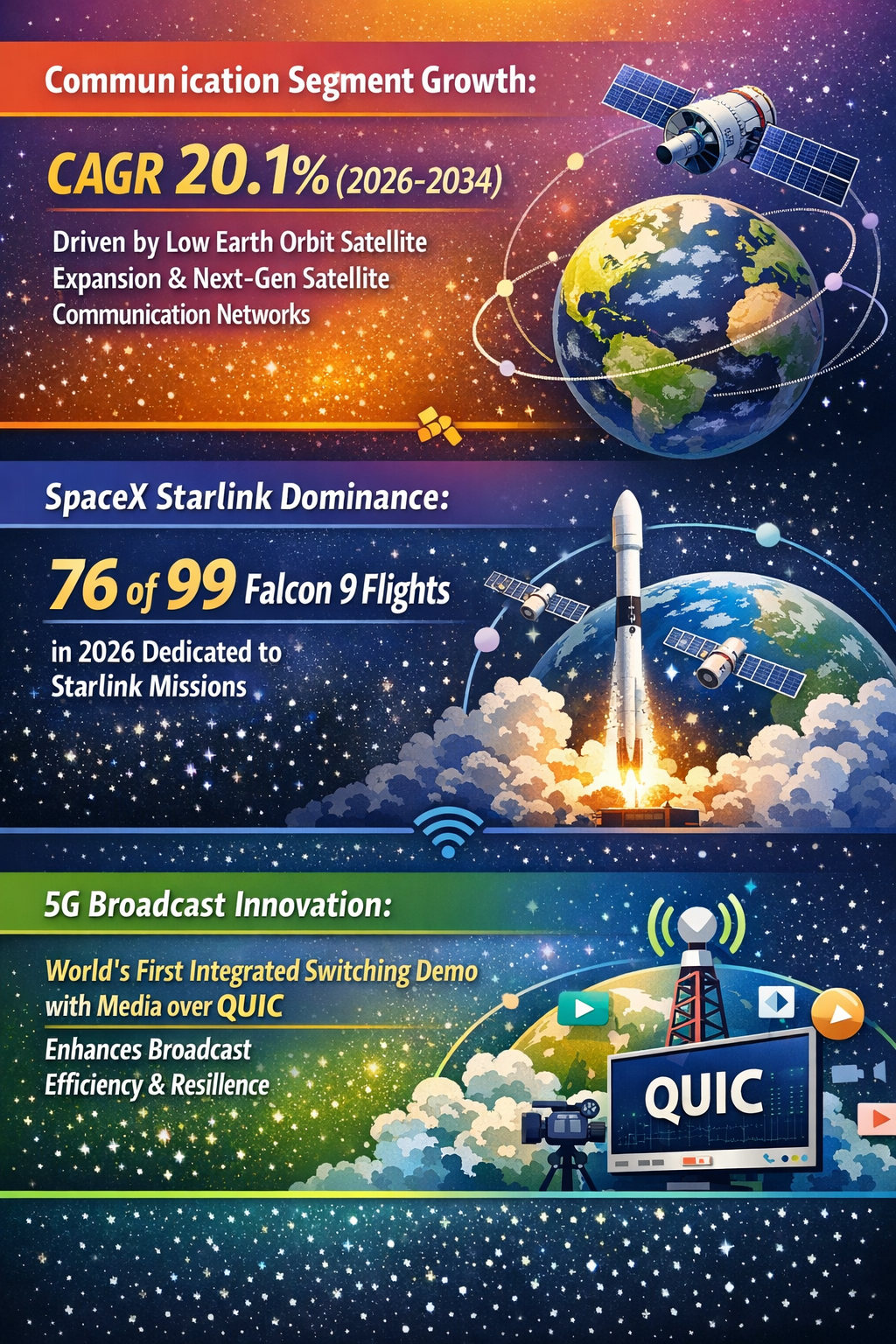
Low Earth Orbit satellite constellations are projected to grow at a compound annual growth rate (CAGR) exceeding 20% through the next decade, underscoring the expanding capital intensity and industrial focus on this area (Straits Research 11/03/2026). Starlink’s ongoing launches, accounting for the majority of Falcon 9 flights in 2026, emphasize SpaceX’s dominance and the scale of deployment underway (Space.com 20/07/2026).
Notably, 5G broadcast and media technology advancements that integrate ultra-low latency protocols (such as Media over QUIC) demonstrate industry efforts to hybridize terrestrial and satellite-based communications into seamless systems, hinting at a future where orbit and ground infrastructure operate as a singular network fabric (Big Blue Marble 02/08/2026).
Disruption Pathway
The progression towards space-based AI hubs interconnected via 6G and LEO satellites may intensify as data volumes from IoT, autonomous systems, and immersive media surge.
Initially, reductions in latency enabled by local AI processing in orbit could accelerate demand for next-generation connectivity supporting real-time applications in defense, finance, and industrial automation. This demand may justify escalating capital investments in orbital infrastructure and 6G terrestrial rollouts.
Existing terrestrial cloud data centers and network controls might face stress from the speed and ubiquity of orbit-to-ground data streams, requiring adaptations such as new hybrid cloud architectures and revised spectrum allocations. Regulatory frameworks would need to evolve to govern not only terrestrial electromagnetic spectrum usage but also orbital resource allocation, cybersecurity standards, and data sovereignty in space-based computing. The European Union’s EU Cyber Resilience Act (EU CRA), which mandates coordinated vulnerability disclosure policies for connected devices, signals early movement towards governing highly distributed networks and may presage future adjustments encompassing orbital assets (Cavli Wireless 29/07/2026).
Industrial structure could adapt as vertically integrated space-tech companies capture upstream manufacturing, launch, satellite operation, and data processing roles, potentially displacing traditional network operators and hyperscalers. A feedback loop may emerge where enhanced connectivity fuels space-based AI capabilities, which in turn demands more robust 6G networks, encouraging deeper collaboration or competition between terrestrial 6G consortiums and space-based infrastructure providers.
Unintended consequences could include geopolitical tensions over orbital AI infrastructure control, risks of orbital debris affecting connectivity reliability, and greater systemic cybersecurity exposures as terrestrial and space-based systems converge.
Why This Matters
Senior decision-makers face potentially transformative shifts in how and where digital infrastructure is deployed, governed, and monetized. Capital allocation decisions may need to balance terrestrial 6G network investments against orbit infrastructure partnerships or build-outs.
Regulators must anticipate cross-jurisdictional challenges involving spectral rights, AI governance, cybersecurity, and infrastructure resilience spanning Earth and orbital environments.
For industrial strategists, integration of space-based AI hubs with terrestrial networks could redefine supply chains—blurring lines between telecom, cloud computing, space launch, and hardware manufacturing sectors—and redefine competitive moats.
Liability shifts could arise as connectivity failures or cyber incidents with impacts extending from orbit-based assets to terrestrial users become more probable, necessitating novel insurance models and shared responsibility frameworks.
Implications
This wildcard could plausibly evolve into a structural change rather than transient hype if orbital AI data centers mature technologically and economically, coupling tightly with 6G networks and growing satellite constellations.
It might lead to a bifurcated industrial landscape in which legacy terrestrial-centric networks coexist uneasily with a new blended orbit-terrestrial infrastructure, reshaping competitive dynamics.
Alternatively, the development may remain niche or incremental if technical, regulatory, or geopolitical hurdles curb orbit-based AI deployment or if 6G rollouts stall.
Notably, this is not merely an extension of Starlink’s broadband ambitions but a fundamentally new architectural paradigm integrating AI processing in space, which challenges assumptions about data localization, processing latency, and network topology.
Competing interpretations exist: some may view orbital AI hubs as cost-prohibitive or high risk in comparison to rapidly advancing terrestrial data centers; others may underappreciate the strategic leverage of in-orbit computing for latency-critical applications.
Early Indicators to Monitor
- Patent filings for space-based AI processing hardware and software architectures
- Venture funding rounds or corporate investments targeting orbital edge computing
- Regulatory initiatives addressing AI governance frameworks combined with orbital data infrastructure
- Consolidation or partnerships between satellite operators and cloud hyperscalers
- 6G standards development incorporating satellite interoperability and ultra-low latency protocols
Disconfirming Signals
- Significant technical failures or prohibitive cost overruns in Starship or similar launch systems reducing orbital payload capacity
- Global regulatory moratoriums or restrictions on in-orbit data centers due to space debris or security concerns
- Dominance of terrestrial AI edge computing solutions rendering orbital processing redundant
- Stalling or fragmentation of 6G standardization leading to disjointed connectivity ecosystems
Strategic Questions
- Should capital be reallocated from terrestrial 6G infrastructure to support emerging space-based AI processing ventures?
- How might regulatory frameworks adapt to govern hybrid orbit-terrestrial connectivity and AI data sovereignty?
Keywords
Orbital AI; 6G Networks; Low Earth Orbit Satellites; Space-Based Data Centers; Connectivity Wildcards; Regulatory Frameworks
Bibliography
- 6G, which is expected to be rolled out in the 2030s, promises a theoretical maximum data-transfer speed of up to 1 terabit per second - approximately 3,000 times faster than average 5G speeds. Live Science. Published 01/04/2026.
- China remains one of the world's most advanced 5G markets, with 1.7 billion 5G connections expected by 2030. GSMA. Published 12/06/2026.
- Eventually, SpaceX hopes to use Starship's high cargo capacity to rapidly build out its satellite Internet constellation, Starlink, and to construct an orbital artificial intelligence data center. Scientific American. Published 15/06/2026.
- The communication segment is projected to register the fastest growth at a CAGR of 20.1% during 2026-2034, supported by the expansion of low Earth orbit satellite constellations and increasing investments in next-generation satellite communication networks. Straits Research. Published 11/03/2026.
- With the world's first integrated switching demonstration between 5G Broadcast and Media over QUIC, stakeholders should expect to see enhanced efficiency and resilience in broadcast services. Big Blue Marble. Published 02/08/2026.
- The EU Cyber Resilience Act (EU CRA) mandates implementing a Coordinated Vulnerability Disclosure (CVD) policy to enhance cybersecurity within the European Union, particularly for products such as IoT devices. Cavli Wireless. Published 29/07/2026.
- Authorities emphasized that India aims to lead global 6G innovation by 2030, in line with the Atmanirbhar Bharat (Self-Reliant India) initiative. Verakworld. Published 16/08/2026.
- As you might expect, Starlink satellites are SpaceX's most common payload; 76 of 2026's 99 Falcon 9 flights have been dedicated Starlink missions. Space.com. Published 20/07/2026.