
The Latent Urban Revolution: Sand Scarcity as a Wildcard for Megacity Futures
Urbanization is accelerating the demand for critical construction inputs, yet an overlooked raw material scarcity—sand—may sharply redefine urban growth trajectories worldwide. This paper explores sand scarcity as a non-obvious wildcard with expansive implications for capital allocation, regulatory frameworks, and industrial strategy in megacity development over the next two decades.
While trends like 3D construction printing and autonomous mobility dominate smart city narratives, the intensifying global sand demand to fuel infrastructure expansion presents a weak signal with potential to disrupt urban supply chains, reshape material sourcing, and force sector-wide adaptations. This insight unpacks how urbanization-driven sand pressure, especially in Asia Pacific, Africa, and Latin America, may trigger systemic inflections in urban planning and construction economics with cascading regulatory ramifications.
Signal Identification
This development qualifies as a wildcard due to its latent nature, underestimated awareness, and high-impact potential on megacity growth fundamentals. Although consumption of sand is essential yet historically unremarked upon, projections show soaring demand tied directly to urbanization patterns (Expert Market Research 06/02/2024). The timeline is medium to long term — approximately 10–20 years — with a medium plausibility band linked to regulatory inertia and substitution innovation. Sectors exposed include construction, urban infrastructure, regulatory agencies, construction technology innovators, and industries dependent on sand-derived materials.
What Is Changing
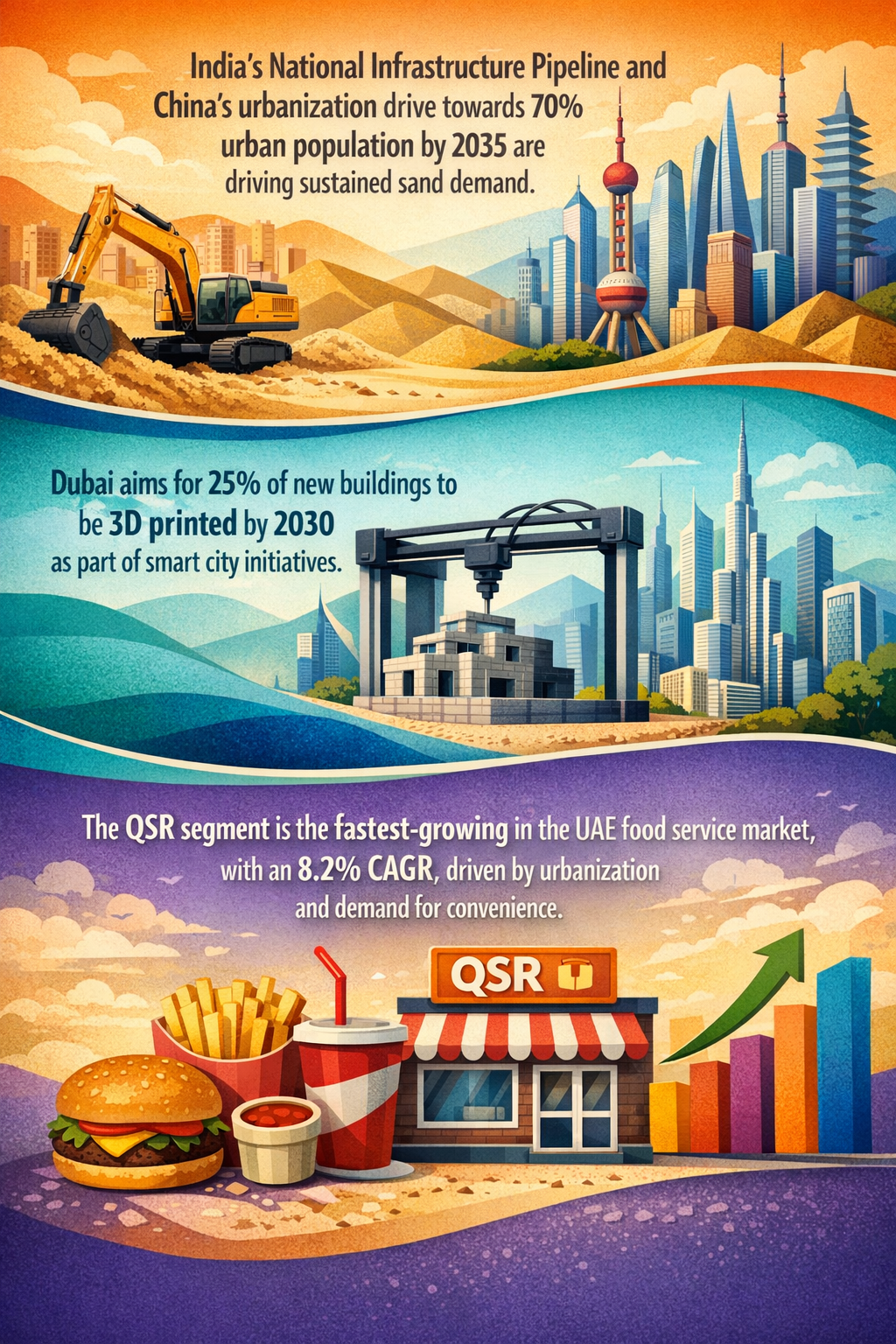
Urban expansion, fuelled by demographic growth and rural-to-urban migration especially in emerging economies, requires massive construction throughput. India’s National Infrastructure Pipeline and China’s urbanization target of 70% urban share by 2035 exemplify this intensifying pressure, driving unprecedented sand consumption worldwide (Expert Market Research 06/02/2024). Sand is fundamental in concrete and glass, the backbone of modern megacity vertical growth and critical infrastructure.
Despite rising interest in technology-driven construction such as Dubai’s ambition to 3D print 25% of new buildings by 2030 (Market Data Forecast 04/01/2024), the raw material input—sand—remains a bottleneck. The increased demand in urban regions across Asia Pacific, Africa, and Latin America is coupled with environmental and regulatory challenges that limit sand extraction (Persistence Market Research 22/03/2024), risk elevating sand scarcity from localized constraint to systemic supply chain crisis.
Emerging urban mobility dynamics like autonomous vehicles also depend on extensive infrastructure evolution (South Summit 30/09/2023), intensifying construction inputs. However, if sand supply fails to follow, these new urban models may confront slowed deployment or cost inflation.
The systemic theme converges on the increasing fragility and geopolitical-economic complexity of megacity material sourcing. Urban growth is exposing inseparability between raw material security, environmental sustainability, and the emergent smart city technological paradigm, underscoring a need to integrate material commons management with urban policy and industrial strategy.
Disruption Pathway
As urban centers expand, sand extraction and transport infrastructure will face rising environmental limits including erosion, habitat destruction, and regulatory resistance. These pressures may result in supply bottlenecks or embargoes, triggering price volatility and material scarcity for urban developers.
This scarcity could incentivize accelerated adoption of alternative construction materials (e.g., recycled aggregates or synthetic substitutes), driving industrial restructuring of building material supply chains. It may also catalyze innovation in modular and 3D-printed construction methods that reduce sand dependence (Market Data Forecast 04/01/2024).
Urban planners and regulators might be forced to embed sand resource management in city masterplans, transitioning from purely spatial planning to integrated ecological-material stewardship. This shift could foster new regulatory frameworks, impact capital flows into infrastructure projects, and alter competitive dynamics favoring vertically integrated builders or technology providers with circular economy capabilities.
Feedback loops could include accelerated urban growth constrained by input limitations, driving demand for more compact, vertically smarter building designs, or triggering second-order shifts in migration patterns as affected cities slow expansion. This creates governance challenges balancing growth ambitions with material sustainability.
Why This Matters
For capital allocators, overlooking sand scarcity risks mispricing infrastructure project costs and investment timelines. Construction firms and material producers face strategic risk from supply shocks. Regulators may need to develop new environmental extraction mandates, permit processes, and urban development standards incorporating resource intensity considerations.
Competitive positioning could shift to firms pioneering low sand-intensity building technologies or alternative supply chains, demanding adaptation in industrial strategy. Supply chain disruptions impose liabilities on megacity developers reliant on just-in-time construction materials. Governance models may need to evolve towards resource-risk-informed planning and interregional cooperation on raw material commons.
Implications
The sand scarcity wildcard could underpin structural change rather than transient price fluctuations, altering urbanization trajectories across emerging megacities. It may catalyse a material paradigm shift that refocuses industrial innovation toward sustainability and circularity in construction.
This development is not simply an environmental or commodity price issue; it signifies a foundational input constraint with downstream urban system effects. Some may interpret rising sand demand as mere economic growth side-effects without system disruption, but evolving environmental scrutiny and resource governance counter this.
Competing interpretations frame sand scarcity either as a niche local challenge or as a sentinel indicating broader raw material insecurities critical for urban futures. This insight sides with the latter, anticipating multi-scalar impact across sectors.
Early Indicators to Monitor
- Patent filings and R&D investment in sand substitutes and low-sand construction technologies
- Regulatory drafts imposing stricter controls on sand mining and transportation
- Capital reallocation trends favoring 3D printing and modular construction firms
- Procurement shifts by urban infrastructure projects citing sustainable material sourcing mandates
- Emergence of international or regional frameworks on sand resource governance
Disconfirming Signals
- Major breakthroughs scaling low-cost, high-performance sand substitutes quickly to market
- Rapid easing of global or local environmental regulations on sand extraction
- Sustained drops in urban infrastructure growth rates due to other unrelated constraints
- Large discovery of new sand resources or alternative sediment sources easing supply pressures
- Failing adoption rates of low sand-intensity construction technologies
Strategic Questions
- How can urban planning integrate raw material security as a core parameter in megacity development decisions?
- What policies or incentives can accelerate innovation and adoption of alternative construction materials mitigating sand dependency?
Keywords
Urbanization; Megacities; Sand Scarcity; Construction Materials; 3D Printing Construction; Smart Cities; Resource Governance; Supply Chain Resilience
Bibliography
- Three D Print Construction Market. Market Data Forecast. Published 04/01/2024.
- Autonomous Mobility in 2026: Technology, Investment and the Future of Transportation. South Summit. Published 30/09/2023.
- Sand Market Report. Expert Market Research. Published 06/02/2024.
- Tea Market Research Report. Persistence Market Research. Published 22/03/2024.
- Global Projections for 2050 and Why They Matter for Peace. World Peace Foundation. Published 19/10/2023.