
Unveiling the Silent Shift: The Growth of Layered Stablecoin-Backed Tokenization as a Structural Inflection in Decentralised Finance
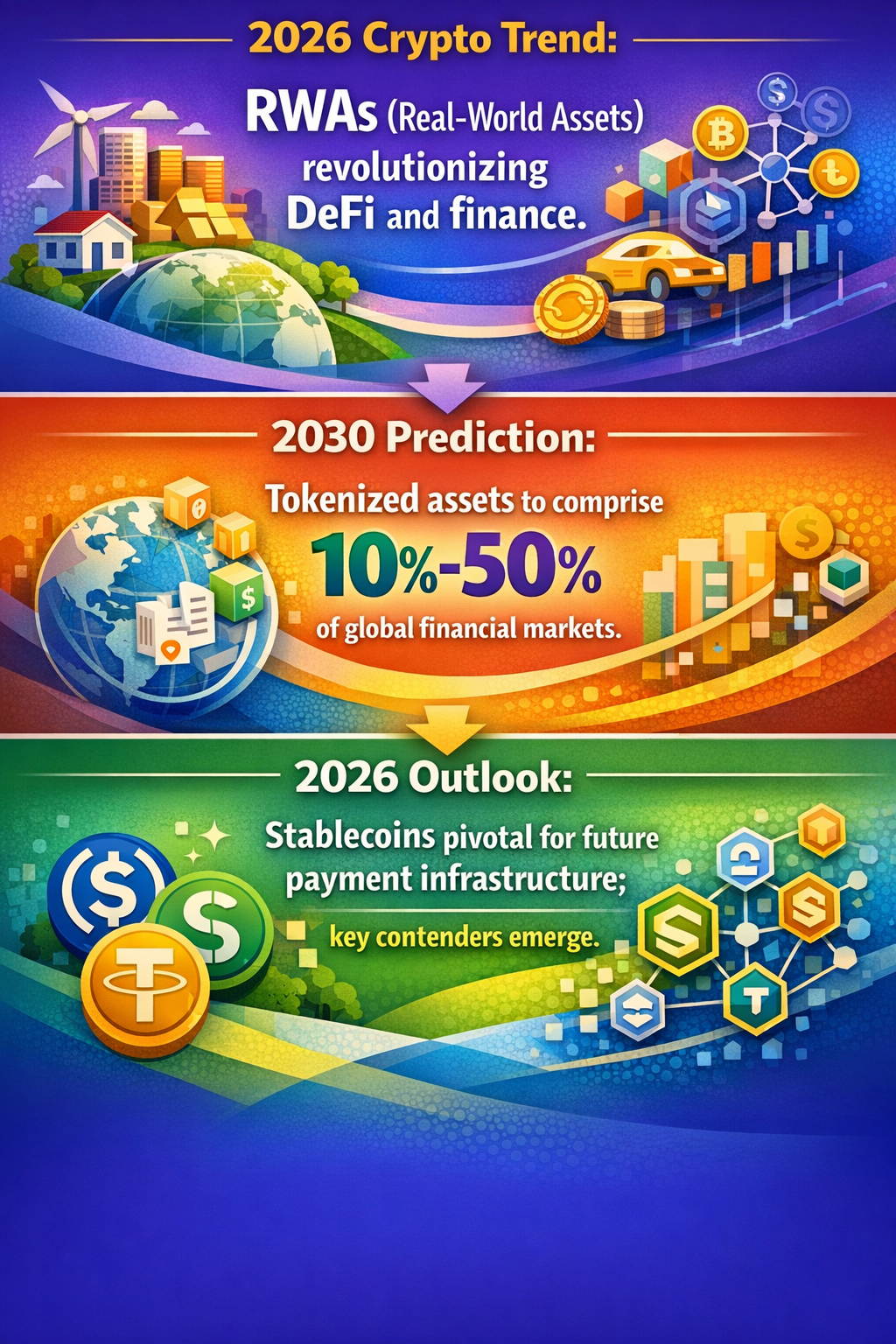
Layered integrations of stablecoins like USDC with real-world asset tokenization are quietly emerging as a non-obvious structural inflection in decentralised finance (DeFi). This has the potential to reshape capital flows, regulatory oversight, and industrial configurations over the next two decades.
While headline metrics often cite the $10 to $16 trillion projection for tokenized assets by 2030, the deeper transformation is occurring at the intersection of payment-functional stablecoins and tokenized real-world assets (RWA). This multi-layered embedding risks being underappreciated in mainstream discourse but could ultimately recalibrate incentives, liquidity, and governance across traditional and decentralised financial ecosystems.
Signal Identification
This development qualifies as an emerging structural inflection indicator. It involves the co-evolution of scalable stablecoin infrastructures—such as USDC variants—and the tokenization of RWAs creating integrated financial primitives usable within, and bridging, decentralised and traditional finance.
The plausibility horizon is medium to high over 10–20 years, given ongoing regulatory calibrations and pilot network effects visible today. The sectors exposed include financial services (capital markets, payments, custody), regulatory/governance bodies, technology infrastructure providers, and industrial players in asset origination and securitization.
What Is Changing
Tokenized asset markets are projected to reach between $10 and $16 trillion by 2030, but this figure alone risks obscuring more fundamental changes in financial infrastructure and capital mobility (starke.finance 22/11/2023). What is underacknowledged is how widely adopted, programmable stablecoins backed by regulated reserves—evidenced by the rise of USDC and its USDCx variant—serve as foundational liquidity and settlement layers within these ecosystems (coinstats.app 15/12/2023).
Canada’s financial regulators highlight stablecoins’ unique systemic risks, citing their increasing role as a means of payment and final settlement in both crypto-native and broader markets (bitcoinfoundation.org 09/10/2023). This confirms that stablecoins are evolving beyond mere trading tokens into critical plumbing layers that blur the line between decentralised and traditional financial infrastructures.
The emerging pattern is a layered stack: real assets (real estate, commodities, bonds) are tokenized and traded on decentralized ledgers, settlement and liquidity are increasingly provided by stablecoins like USDC, and protocols such as USDCx enable enhanced usability and cross-chain interoperability. Coupled with regulated on-ramps and interoperability standards, these layers combine to create hybrid financial ecosystems that could rival traditional capital markets in efficiency and accessibility.
This layered stablecoin-backed tokenization ecosystem is structurally different from earlier crypto asset bubbles or standalone DeFi primitives because it leverages regulatory-compliant stablecoins with real-world asset collateralization, thus facilitating institutional adoption and regulatory engagement in ways prior DeFi generations struggled to achieve.
Disruption Pathway
If this signal intensifies, the following sequential dynamics could ensue: First, expanded adoption of regulated stablecoins as settlement infrastructure (including programmable variants like USDCx) will accelerate integration of tokenized RWAs as viable digital securities and collateral assets. Increased institutional and retail participation in this layered stack could disrupt traditional liquidity pools and market-making paradigms.
Second, existing capital market participants face pressures as liquidity and settlement migrate toward blockchain-native rails augmented by programmable stablecoins. This could stress traditional intermediaries and custodians who lack native blockchain integration or risk reporting capabilities compliant with evolving standards.
Subsequent structural changes may involve regulatory recalibration. Regulators may need to shift from siloed oversight of crypto-assets and traditional securities toward holistic frameworks that encompass tokenized RWAs settled via stablecoins. This could foster new licensing regimes focused on integrated ecosystem governance rather than isolated entities.
Layered token ecosystems may generate feedback loops where enhanced liquidity and lower friction in capital markets attract more asset tokenizations, further increasing demand for stablecoin liquidity. Conversely, liquidity crises in stablecoins could cascade through tokenized asset markets, underscoring systemic risk concerns and prompting new regulatory interventions.
Finally, dominant financial networks and infrastructure providers could reposition themselves either to embrace or resist this shift. Strategic alliances between stablecoin issuers, asset tokenizers, and regulated financial institutions may coalesce into a new industrial architecture blending decentralised protocols and regulatory safe harbors.
Why This Matters
For capital allocators, recognizing the layered stablecoin-tokenized asset stack as an unfolding structural transformation is critical to identify emerging liquidity vectors and asset classes that could outperform or disrupt incumbent market instruments.
Regulators must anticipate integrated risk profiles arising from intertwined stablecoin issuance, RWA tokenization, and decentralized settlement layers, requiring coordinated cross-jurisdictional frameworks rather than treating these components separately.
Industrial strategy and competitive positioning will hinge on the ability to engage with multi-actor ecosystems spanning protocol developers, asset originators, stablecoin issuers, and custodians. Early movers may capture significant market share in next-generation financial infrastructure, while laggards risk obsolescence.
Governance consequences include new modalities for financial oversight that incorporate both programmable compliance mechanisms and decentralized coordination, challenging existing liability paradigms and supervisory approaches.
Implications
This development could plausibly scale into lasting structural change, reshaping capital allocation patterns by enabling broader investor participation in previously illiquid assets on programmable, stablecoin-backed networks. Such shifts may facilitate new forms of collateralization and credit extension, impacting credit cycles and monetary transmission channels.
Regulatory frameworks might evolve to create hybrid regimes reflecting the hybrid nature of these ecosystems, requiring novel supervisory tools encompassing both technological and financial risk domains. Industrial ecosystems might move from siloed sectors toward integrated consortia or platforms merging aspects of DeFi and institutional finance.
This signal is unlikely to be transient noise, as it combines multiple scalable and regulated-ready components reinforcing each other’s growth. However, alternative interpretations may see regulatory clampdowns or stablecoin governance failures curtailing momentum, or traditional institutions successfully digitizing assets without decentralisation.
Early Indicators to Monitor
- Volume and total value locked (TVL) in USDC-backed tokenized real-world assets across multiple chains.
- New regulatory frameworks or whitepapers explicitly referencing layered stablecoin and asset tokenization ecosystems.
- Launch of interoperable stablecoin variants with programmable features (e.g., USDCx) gaining institutional adoption.
- Venture funding rounds and strategic partnerships between stablecoin issuers and asset originators.
- Standards formation initiatives addressing settlement, custody, and compliance for combined tokenized asset-stablecoin transactions.
Disconfirming Signals
- Major stablecoin issuers losing regulatory approval or failing compliance audits, triggering liquidity collapses.
- Fragmentation or incompatibility across tokenization protocols and stablecoin infrastructures inhibiting interoperability.
- Persistent regulatory fragmentation resulting in conflicting regimes that disincentivize institutional adoption.
- Entrenchment of traditional capital market infrastructure without meaningful integration of programmable stablecoins.
Strategic Questions
- How can organizations position themselves to leverage the convergence of stablecoin liquidity and real-world asset tokenization without overexposing to nascent regulatory risk?
- What governance frameworks and technological standards are needed to effectively supervise and enable secure, scalable interactions between stablecoin networks and tokenized real-world assets?
Keywords
Stablecoins; Tokenization; Decentralized Finance; Real World Assets; Regulation; Liquidity; Financial Infrastructure; Industrial Strategy; Programmable Money
Bibliography
- The Canadian regulators assess that stablecoins pose unique risks to the financial system relative to other crypto-assets, given their potential use case as a means of payment and settlement. bitcoinfoundation.org. Published 09/10/2023.
- The $10 to $16 trillion projection for tokenized assets by 2030, cited across BCG and Citi GPS research, gets repeated often enough that it risks becoming background noise. starke.finance. Published 22/11/2023.
- USDCx stablecoin growth: Access to USDC-backed infrastructure could reduce Cardano's historical liquidity disadvantage and improve DeFi, payments, and institutional use. coinstats.app. Published 15/12/2023.
- Global Stablecoin Regulatory Developments 2023: Maintaining Financial Stability and Innovation Balance. International Monetary Fund. Published 01/08/2023.
- Tokenized Assets and Their Impact on Capital Markets: Framework and Prospects. Boston Consulting Group. Published 14/09/2023.